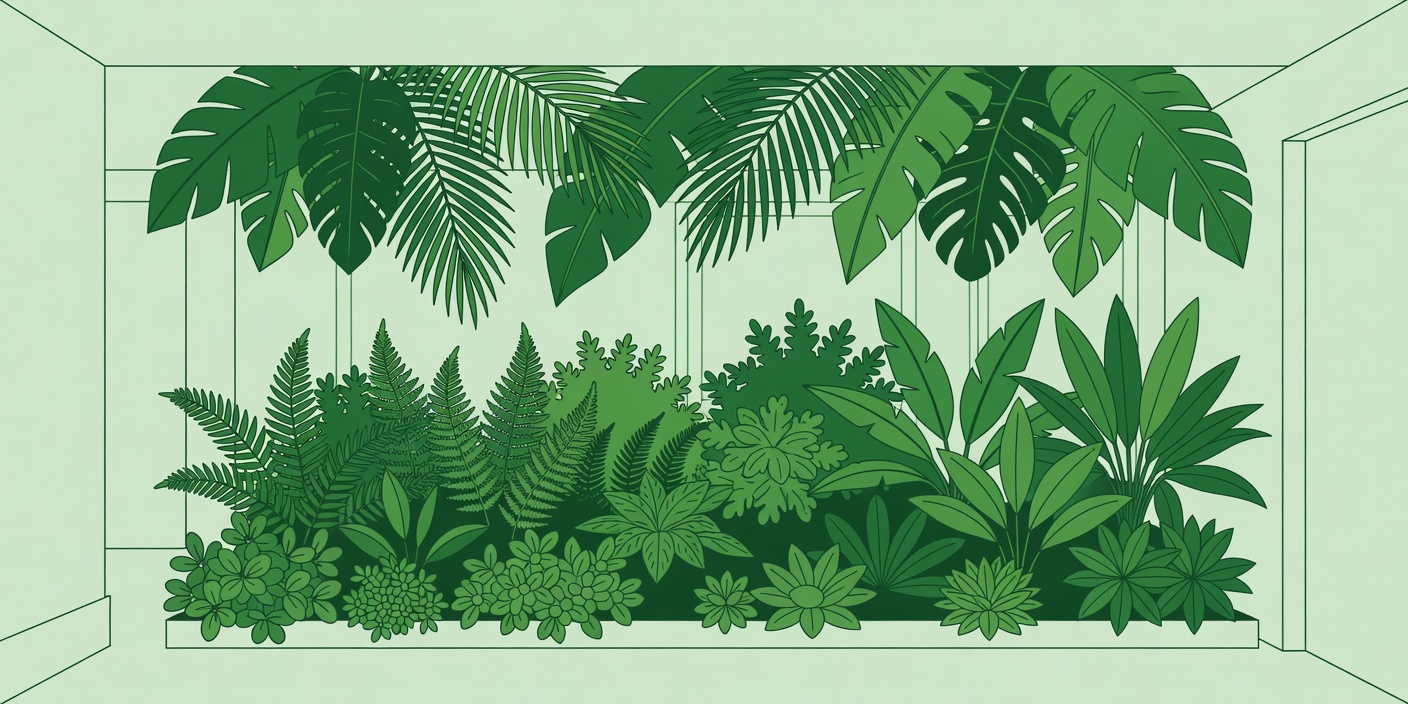
A memorable indoor garden often contains fewer gestures than first appears. One canopy establishes the room’s scale; a quieter layer gives depth; a carefully chosen vessel connects the planting to the architecture.
The aim is not to reproduce a tropical forest indiscriminately. Homes have circulation routes, furniture, changing daylight and people with different tolerances for maintenance. A composition becomes convincing when its visual ambition and horticultural requirements can occupy the same space.
Choose a leading silhouette
Begin with the view that matters most: arrival through a doorway, a seated view across a living room or the transition between kitchen and terrace. Identify one primary planting position rather than distributing equally prominent specimens around every corner. A strong silhouette reads more clearly when it has a calm background and enough negative space around its leaves.
Consider the mature shape, not just the plant at purchase. An upright juvenile may become broad and arching. A climbing species may require a visible support. A specimen whose leaves extend into a corridor will eventually be pruned for access, whether or not that suits its intended form. Draw the likely envelope and check it against doors, curtains and seating.
Build layers without clutter
Canopy, understory and ground-level planting are useful compositional ideas, but a small room need not contain all three. A tall plant with a clean trunk and a single low companion can establish enough hierarchy. Repeating the same container material or a related leaf shape can provide continuity without increasing species count.
Contrast works best when controlled. Pairing a broad, simple leaf with a finely divided frond can create a legible difference in texture. Adding several unrelated variegations, highly coloured pots and multiple leaf scales may make the arrangement visually restless. View the scheme in silhouette first; introduce finer distinctions only after the overall balance is clear.
Read plants as individuals
The following profiles are starting points for discussion, not universal recommendations. Confirm the exact species or cultivar, the conditions it has been grown in and its suitability for the household. Botanical names help avoid confusion where common names overlap.
Ficus elastica
The rubber plant offers a strong, often upright leaf rhythm. It generally suits bright conditions and needs room for developing branches. Its latex can irritate skin, and it should not be treated as a pet-safe choice.
Howea forsteriana
The kentia palm creates a softer canopy with arching fronds. Allow for lateral spread and avoid positioning frond tips in frequent circulation. Good drainage and appropriate light remain important despite its reputation for adaptability.
Monstera deliciosa
Mature foliage can be expansive, particularly when the plant has appropriate support. Account for aerial roots and the width of developing leaves. Calcium oxalate crystals make ingestion a concern for children and pets.
Aspidistra elatior
A useful candidate for comparatively modest light, with broad upright leaves and a restrained habit. Tolerance of lower light does not remove the need for suitable conditions or careful watering.
Keep compatibility beneath the surface
Plants that look harmonious may require different root environments. A fern preferring evenly moist conditions should not automatically share an undivided root zone with a species that needs a more pronounced drying interval. Similar foliage colour is not evidence of compatible watering needs.
Separate nursery pots inside a coordinated planter can preserve a unified appearance while allowing individual watering, inspection and replacement. Do not hide that flexibility under a permanent decorative surface that makes every intervention disruptive. Leave the arrangement serviceable, and identify each plant in the care record.
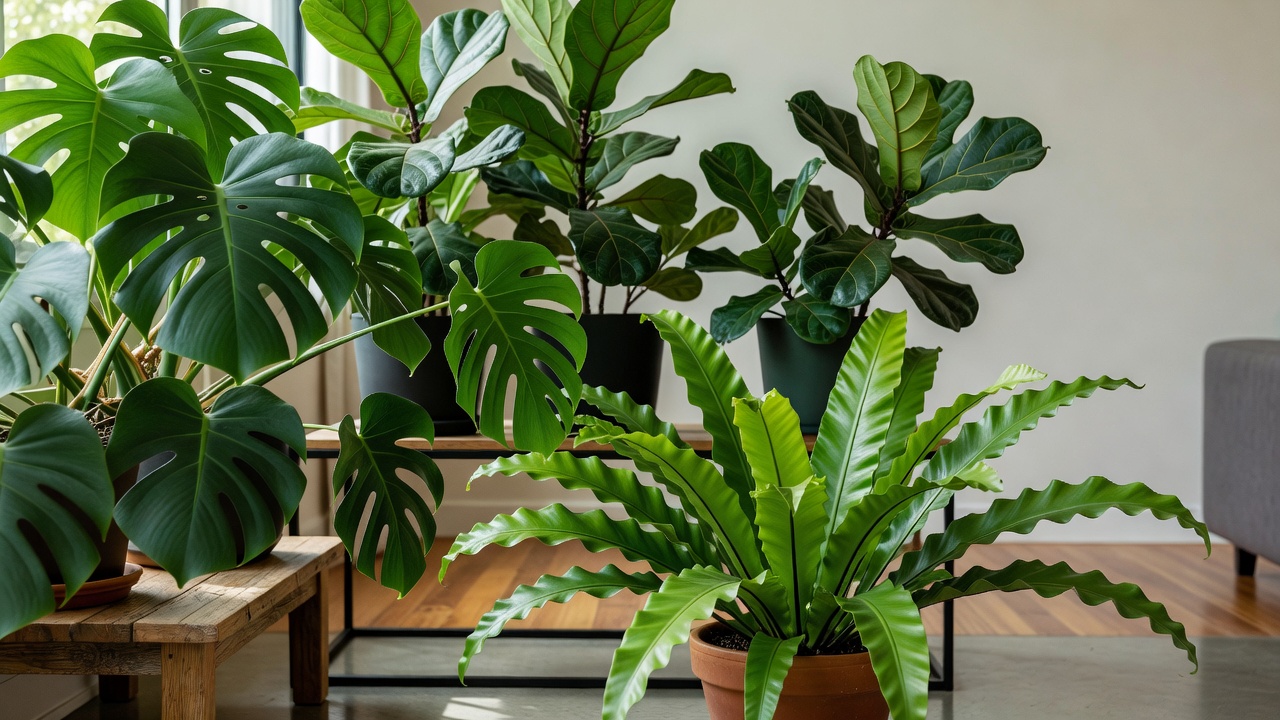
Use material restraint
Planters should relate to the home without pretending to be architecture they cannot safely perform as. Stone, ceramic and metal each have implications for weight, heat transfer, water resistance and handling. A porous exterior finish may mark if repeatedly exposed to moisture. A narrow opening can prevent removal of a root ball even when the overall vessel seems generously sized.
Test the composition with temporary shapes or a simple full-size mock-up. Look at it from seated height and after dark. A dark leaf against a dark wall may disappear; a glossy leaf under a narrow spotlight may produce distracting reflections. These are opportunities to edit the room, not reasons to force additional plants into it.
Select for the household
Check toxicity against a dependable species-specific source, such as the ASPCA plant database for pets, and seek veterinary or medical advice when exposure is a concern. Keep thorns, heavy unstable pots and accessible fertilisers in the risk assessment. No attractive photograph can establish that a plant is suitable for every home.
When sourcing, favour a reputable nursery with clear plant identification and care history. The Royal Botanic Gardens, Kew’s Plants of the World Online is useful for checking accepted names. The RHS offers practical cultivation guidance. Collections at the Barbican Conservatory and the Palm House at Kew can inspire spatial observation, but their environments should not be assumed to match a domestic room.
Practical note: edit before adding
Photograph the arrangement and temporarily remove one secondary element. If the principal silhouette becomes clearer, keep the simpler version. Reassess after a period of growth rather than filling every empty space immediately.